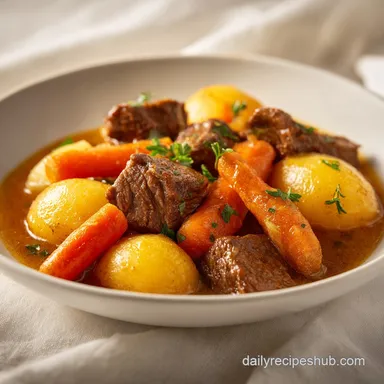
Slow Cooker Beef Stew: Tender and Hearty
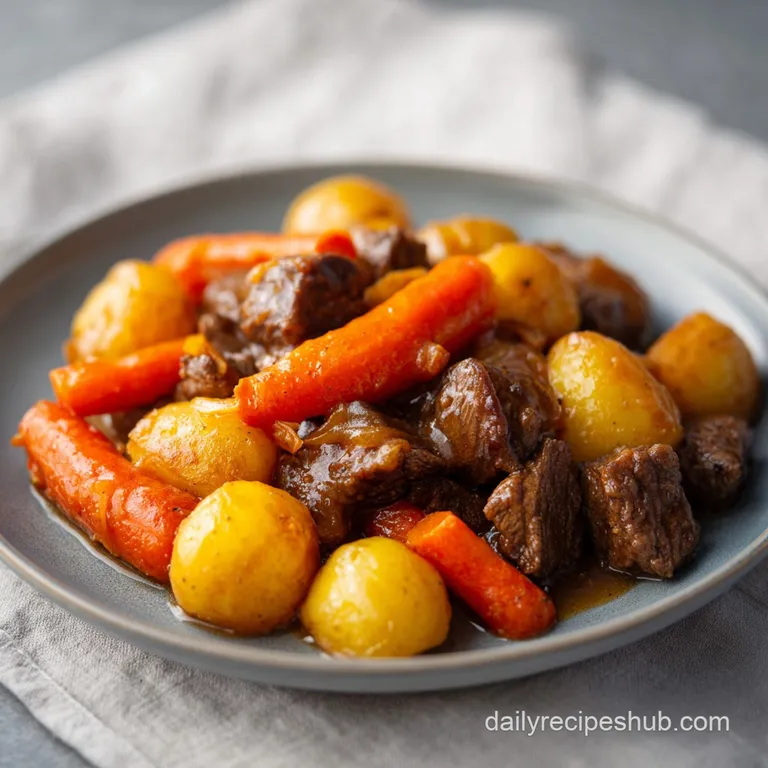
- Time:20 minutes active + 8 hours cooking = Total 8 hours 20 mins
- Flavor/Texture Hook: Fork tender beef in a glossy, velvety gravy
- Perfect for: Cold rainy nights, budget-friendly meal prep, and beginner cooks
- Best Slow Cooker Beef Stew Recipe
- Why This Comfort Food Works
- Budget Shopping List Guide
- Essential Kitchen Tools Needed
- Step-by-Step Cooking Guide
- Common Fixes and Pitfalls
- Troubleshooting Common Issues
- Clever Swaps and Variations
- Adjusted Proportions for Different Sizes
- Kitchen Myths Debunked
- Storage and Waste Tips
- Ideal Side Dish Pairings
- Recipe FAQs
- 📝 Recipe Card
That first sizzle when the beef hits the hot oil is where the magic starts. I remember the first time I tried to skip the searing step because I was running late. I just tossed everything in the pot and hoped for the best. The result?
The meat was grey, the broth tasted thin, and the whole thing felt like something from a hospital cafeteria. It was a total letdown.
Then I learned about the "hero" of this dish: beef chuck. Most people buy those pre cut "stew meat" packs, but those are often random lean scraps that turn into rubbery pebbles. When you use a proper chuck roast and take the time to get a deep, dark brown crust on each cube, you're building a foundation of flavor that a slow cooker alone can't create.
This slow cooker beef stew is all about patience and smart choices. We're taking a cheap, hardworking cut of meat and using time as our secret ingredient. You'll end up with a bowl that smells like a cozy cottage and tastes like you spent all day hovering over a stove, even though the machine did the heavy lifting.
Best Slow Cooker Beef Stew Recipe
Right then, let's get into why this specific approach beats the generic versions. Most recipes tell you to just "dump and go," but that's how you get a watery soup rather than a rich stew.
By layering the flavors and using a cornstarch slurry at the end, we get that glossy, coat the-back of-the spoon consistency that makes a meal feel hearty.
The goal here is a balance of textures. You want the beef to just barely hold its shape before it melts in your mouth, and the carrots to be tender but not completely disintegrated into mush. It's a fine line, but the 8 hour low setting is the sweet spot for this.
I've found that adding a splash of red wine and a dollop of tomato paste creates a depth of flavor that mimics a traditional French beef bourguignon without the fancy price tag. It adds a subtle acidity that cuts through the richness of the beef fat, making every bite feel balanced.
Why This Comfort Food Works
I used to think the slow cooker just "cooked things," but there's actually a lot happening inside that ceramic pot. Here's the lowdown on why this method is the way to go:
- Collagen Breakdown: Beef chuck is full of connective tissue called collagen. Over 8 hours, this slowly transforms into gelatin, which gives the sauce that velvety mouthfeel.
- Gentle Heat: Unlike a boiling pot, the slow cooker prevents the muscle fibers from tightening up too quickly, meaning the meat stays juicy instead of becoming stringy.
- Flavor Infusion: Because the lid stays on, the aromatic steam from the thyme and bay leaves is trapped, forcing those flavors deep into the vegetables.
- Slow Reduction: The long cook time allows the red wine and beef broth to meld, creating a unified savory base rather than tasting like separate ingredients.
Since we're focusing on a budget smart approach, it's helpful to see how this compares to other methods. I've tried doing this in a pressure cooker, and while it's faster, you lose that specific developed depth.
| Feature | Fast (Pressure Cooker) | Classic (Slow Cooker) | Impact |
|---|---|---|---|
| Texture | Uniformly soft | Layered, melting | Slow cooker wins on mouthfeel |
| Flavor | Clean, bright | Deep, caramelized | Classic method is more robust |
| Time | 1-2 hours | 8 hours | Fast is better for emergencies |
| Effort | Medium | Low | Slow cooker is "set and forget" |
Budget Shopping List Guide
When you're shopping for a slow cooker beef stew, the cut of meat is where you can either save money or waste it. I always go for the beef chuck. According to the USDA FoodData, chuck is higher in fat and connective tissue than lean rounds, which is exactly what we want for a long braise.
Component Analysis
| Ingredient | Science Role | Pro Secret |
|---|---|---|
| Beef Chuck | Primary structure & gelatin | Buy the whole roast and cube it yourself to save money |
| Red Wine | Acidity & color | Use the cheapest dry red you like drinking |
| Tomato Paste | Umami booster | Sauté it slightly with the garlic for deeper flavor |
| Cornstarch | Thickening agent | Always mix with cold water first to avoid clumps |
The Full List
- 2 lbs beef chuck, cut into 1 inch cubes Why this? High collagen content for a silky sauce
- 1 tbsp olive oil Why this? High smoke point for searing
- 1 tsp kosher salt Why this? Coarser grains for easier seasoning control
- ½ tsp cracked black pepper Why this? Bold heat that stands up to the beef
- 1 lb baby potatoes, halved Why this? Hold their shape better than russets
- 3 large carrots, sliced into thick rounds Why this? Thick cuts prevent them from turning to mush
- 2 stalks celery, chopped Why this? Adds a necessary herbal baseline
- 1 medium yellow onion, diced Why this? Balanced sweetness and pungency
- 4 cloves garlic, minced Why this? Fresh garlic is non negotiable for depth
- 3 cups low sodium beef broth Why this? Allows you to control the salt levels
- ½ cup dry red wine Why this? Adds acidity and a professional finish
- 2 tbsp tomato paste Why this? Concentrated umami and rich color
- 1 tbsp Worcestershire sauce Why this? Adds fermented depth and saltiness
- 2 bay leaves Why this? Subtle floral note to cut through fat
- 1 tsp dried thyme Why this? Classic earthy pairing for beef
- 2 tbsp cornstarch Why this? Creates a glossy, stable thickening
- 2 tbsp cold water Why this? Necessary to dissolve cornstarch
If you're looking to swap things out to save a few bucks or change the vibe, check this table. Just remember that some swaps change the final texture.
| Original Ingredient | Substitute | Why It Works |
|---|---|---|
| Dry Red Wine | Beef Broth + 1 tbsp Balsamic Vinegar | Mimics acidity. Note: Lacks the complex tannins of wine |
| Baby Potatoes | Diced Yukon Gold (1 inch) | Similar waxy texture. Note: Cut larger to avoid overcooking |
| Beef Chuck | Pork Shoulder | Similar fat/collagen ratio. Note: Changes flavor to a pork stew |
| Cornstarch | All purpose Flour (equal amount) | Standard thickener. Note: Gives a matte finish, not glossy |
Essential Kitchen Tools Needed
You don't need a professional kitchen for this, but a few tools make it way easier. I use a standard 6 quart slow cooker. If yours is smaller, you might need to halve the recipe or you'll risk it overflowing.
You'll also need a heavy skillet. Cast iron is my go to because it holds heat so well, which is key for that deep brown sear. If you use a thin non stick pan, the meat tends to steam rather than brown, and you'll miss out on that critical flavor.
Finally, have a small bowl and a whisk ready for the slurry. Trying to sprinkle cornstarch directly into a hot stew is a recipe for "flour dumplings" that you didn't ask for.
Step-by-step Cooking Guide
Let's crack on. The secret is in the order of operations. Don't just dump; layer.
- Season beef cubes with salt and pepper. Sear in a skillet over medium high heat with olive oil until a deep brown crust forms on all sides. Note: Work in batches so you don't crowd the pan and steam the meat.
- In the same skillet, sauté diced onions and minced garlic for 2 minutes until the onions are translucent and the pan is deglazed. Note: Use the moisture from the onions to scrape up those brown bits (fond) from the meat.
- Transfer the seared meat and the sautéed aromatics into the slow cooker.
- Layer the halved baby potatoes, sliced carrots, and chopped celery on top of the beef. Note: Putting veggies on top prevents them from overcooking against the bottom heat source.
- Whisk together low sodium beef broth, red wine, tomato paste, and Worcestershire sauce in a pitcher. Pour the liquid over the vegetables and add bay leaves and thyme.
- Cover and set the slow cooker to Low for 8 hours until the beef is fork tender and pulls apart easily.
- Whisk cornstarch and cold water in a small bowl to create a smooth slurry.
- Stir the slurry into the stew during the last 30 minutes of cooking. Note: Stir gently so you don't break up the vegetables.
- Leave the lid slightly ajar for the final 15 minutes until the sauce reduces into a glossy, thick consistency.
Chef's Note: If you're in a rush, you can cook this on High for 4-5 hours, but I really recommend the Low setting. The slower the heat, the more the collagen breaks down, and that's where the velvety texture comes from.
Common Fixes and Pitfalls
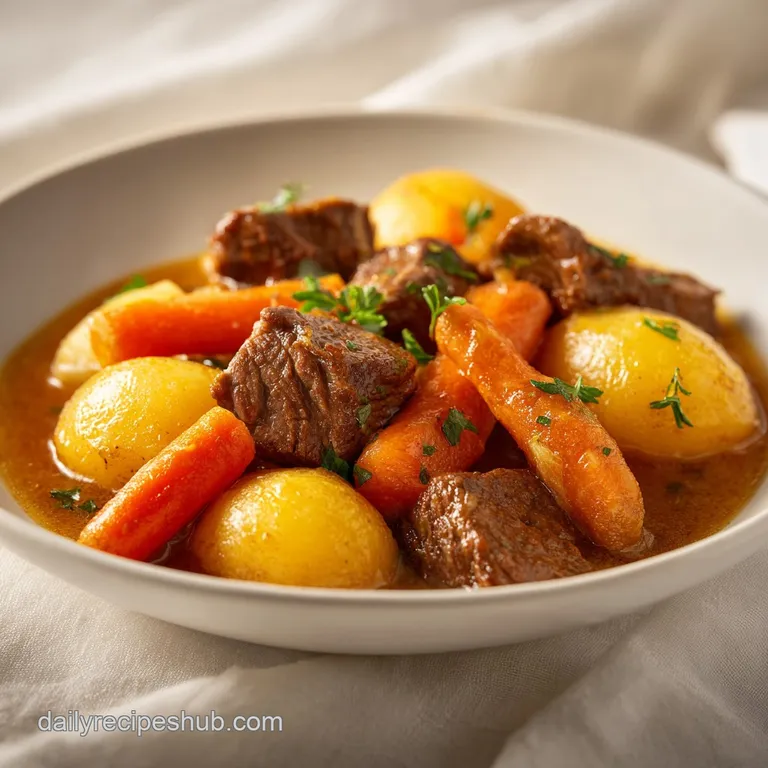
Even for seasoned cooks, a slow cooker beef stew can go sideways. Usually, it's a matter of liquid ratios or heat management.
Troubleshooting Common Issues
| Issue | Solution |
|---|---|
| Why Your Meat Is Tough | If the beef is still chewy after 8 hours, you likely used a cut that was too lean, like sirloin or round. These cuts don't have the collagen needed to break down; instead, they just get tighter and dr |
| Why Your Veggies Are Mushy | This usually happens when carrots and potatoes are placed at the very bottom of the pot. The bottom is the hottest part of the slow cooker. Always layer your root vegetables on top of the meat. |
| Why Your Stew Is Watery | If your stew looks more like a soup, you probably skipped the slurry or didn't let the lid stay ajar at the end. A bit of evaporation is necessary to concentrate those flavors. |
Common Mistakes Checklist:
- ✓ Avoided using "stew meat" packs in favor of beef chuck.
- ✓ Searing meat until deeply browned, not just grey.
- ✓ Layering vegetables on top of the protein.
- ✓ Using a slurry instead of raw flour/starch.
- ✓ Checking tenderness with a fork before adding the thickener.
Clever Swaps and Variations
One of the best things about this recipe is how adaptable it is. If you're not in the mood for the classic version, you can pivot easily. For example, if you want something with a different protein profile, you could try my Beef Stuffed Bell Peppers for a leaner, oven baked alternative.
Boosting the Umami
To take the flavor to the next level, try adding a tablespoon of soy sauce or a teaspoon of fish sauce. It sounds weird, but the fermented saltiness enhances the beefiness without making it taste like soy or fish.
Adding Savory Dumplings
If you want to make this a truly massive meal, drop some biscuit style dumplings on top of the stew during the last hour of cooking. Keep the lid closed tight so they steam through.
Creating a Wine Free Version
If you're avoiding alcohol, don't just replace the wine with more broth. You need that acidity. A mix of beef broth and a tablespoon of red wine vinegar or lemon juice does the trick.
Making it Paleo or Keto
For a low carb version, swap the potatoes for radishes or cauliflower florets. Radishes lose their "bite" when slow cooked and take on a texture very similar to a potato. If you're looking for other beef heavy ideas, my Beef and Broccoli Ramen Stir Fry is a great way to use similar cuts of meat in a faster format.
Adjusted Proportions for Different Sizes
Scaling a slow cooker beef stew isn't as simple as doubling everything. Liquids behave differently in a larger pot because there's less surface area for evaporation relative to the volume.
Scaling Down (Half Recipe): Use a 3 quart slow cooker if you have one. Reduce the cooking time by about 20% since the smaller mass heats through faster. Be careful with the salt, as it can concentrate more quickly in smaller batches.
Scaling Up (Double Recipe): If you're using an 8 quart pot, don't double the salt or thyme, start with 1.5x and taste at the end. Liquids should be reduced by about 10% because a full pot traps more steam and produces more of its own liquid.
Baking Adjustments: If you decide to finish this in the oven (which I sometimes do to get a crust on top), transfer to a Dutch oven at 325°F (160°C) for the final 30 minutes.
Kitchen Myths Debunked
There are a lot of "rules" about beef stew that are actually just myths. Let's clear a few up so you can cook with confidence.
- "Searing seals in the juices." This is a total lie. Searing doesn't create a waterproof barrier; it actually lets moisture escape. However, we still do it because of the flavor created by browning the meat.
- "You must use a specific brand of slow cooker." Nope. Whether it's a fancy programmable one or a 20 year old Crock Pot, the physics of low heat are the same. Just ensure the lid fits tightly.
- "Adding flour to the meat before searing is mandatory." It's a common technique, but it often leads to burnt flour bits at the bottom of the pot. I prefer the cornstarch slurry at the end for a cleaner, glossier result.
Storage and Waste Tips
This dish is a meal prep dream because the flavor actually improves after a day in the fridge. The spices have more time to penetrate the meat.
Storage Guidelines: Store leftovers in airtight containers in the fridge for up to 4 days. If you're freezing it, let it cool completely first. It stays great in the freezer for up to 3 months.
Reheating: Avoid the microwave if you can. Put the stew back in a pot over medium low heat. If the sauce has thickened too much in the fridge (which it will, thanks to the gelatin), just stir in a splash of water or beef broth to loosen it up.
Zero Waste Ideas: Don't throw away the beef trimmings from when you cube the roast. Toss those small scraps into the pot, they'll melt away and add even more richness to the sauce.
If you have leftover carrots or celery ends, freeze them in a "stock bag" to make your own beef broth for the next batch.
Ideal Side Dish Pairings
Since the slow cooker beef stew is so rich and heavy, you want sides that provide a bit of contrast. Something bright, acidic, or crunchy helps balance the meal.
A crusty piece of sourdough bread is the gold standard here. You need something to mop up that velvety gravy. If you want something healthier, a simple arugula salad with a lemon vinaigrette provides the perfect peppery bite to cut through the fat.
For those who want a more complete feast, mashed cauliflower or a steamed pile of buttered peas works well. Avoid serving this with rice or pasta unless you're really hungry, as the potatoes already provide plenty of starch. It's all about balancing that deep, savory weight with something fresh.
Recipe FAQs
Can I put raw beef in a slow cooker stew?
Yes, but you lose depth. Searing beef in olive oil first creates a deep brown crust and fond that significantly improves the overall flavor of the broth.
How to make the best beef stew in a slow cooker?
Sear the beef and layer the vegetables. Follow the 8-hour low-heat method and finish with a cornstarch slurry to achieve a professional, glossy consistency.
Is it true that I must brown stew meat before putting it in the crockpot?
No, this is a common misconception. While the meat will cook through without it, searing is the key to achieving the rich color and savory taste of a traditional stew.
Is beef stew good for cholesterol?
No, typically it is not. Beef chuck is a fatty cut containing saturated fats that can raise cholesterol levels if consumed frequently.
Why are my vegetables mushy in the slow cooker?
You likely placed them at the bottom. Always layer your baby potatoes and carrots on top of the meat, as the bottom of the pot is the hottest zone.
How to fix a watery beef stew?
Stir in a cornstarch slurry. Whisk cornstarch with cold water, add it 30 minutes before finishing, and leave the lid slightly ajar for the last 15 minutes to reduce the sauce.
How long can I store beef stew in the refrigerator?
Keep it for up to 4 days. For those who enjoy the efficiency of meal prepping this stew, our keto taco bake is another excellent option for batch cooking.
Slow Cooker Beef Stew for 8 Servings